One of my pleasures in retirement is re-reading books that were important to me during my past life as a young man. I’m interested to see how the same cultural object will strike me here, in my current life as seasoned reader and experienced human. These books spoke to me then. What will they say to me now?

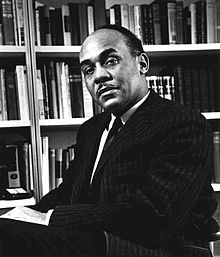
Not too long ago, I re-read a work that, in 1978, blew my mind. It is the coming-of-age-into-racist-America tale, Invisible Man, published in 1952 by Ralph Ellison.
As a callow 17 year old, I harbored the racism of low expectations for African-American authors (having read works by black poets only, and supposing that without a great novel, a people’s culture couldn’t amount to much).
What did I know?
My experience with coming-of-age stories in American fiction had been exclusively with white young men–Hemingway’s Nick, Twain’s Huck. Ellison’s bildingsroman, with its nameless narrator, blew past racial distinctions with a shockingly human, urgently political story. Invisible Man made me feel seen, articulating how I felt, a young man emerging into adult society and finding it corrupt. The narrator, a black man, spoke my situation, which astonished me. It exposed my inherent racism while complicating and broadening my sense of being American. For that alone, I owe Ralph Ellison huge thanks.
As I supposed it would, the book richly repaid re-reading. This time through, I was able to appreciate many things I missed my first time. Among them:
- The audacious descriptions–of the explosion in the (white) paint factory, the pre-Ken Kesey nightmare of electroconvulsive shock therapy, and the narrator’s epiphany as he emerges from the horror of the hospital to discover his wondrous fear-ectomy. Powerful writing!
- The negative portrayal of unionism, which almost outdoes Elie Kazan’s On the Waterfront (1954).
- The way the book draws from the transcendentalist tradition of American literature, putting it in conversation with French existentialism. Emerson’s idealism encounters Camus’ reckoning with the absurdity of human suffering. You can hear it in quotations such as this, in which the protagonist reflects on all his sufferings and concludes that they have been worth it.: “I feel the need to reaffirm all of it, the whole unhappy territory and all the things loved and unloveable in it, for it is all part of me.” And then about our national project: “America is woven of many strands; I would recognize them and let it so remain. It’s “winner take nothing” that is the great truth of our country or of any country. Life is to be lived, not controlled; and humanity is won by continuing to play in face of certain defeat. Our fate is to become one, and yet many.”
- Along those lines, I was struck by the narrator’s embrace of inter-space, the unseen “invisible” spaces in-between, of ambivalence, and being for and against our country. He both loves and hates America, denounces and defends it: “I denounce because though implicated and partially responsible, I have been hurt to the point of abysmal pain, hurt to the point of invisibility. And I defend because in spite of all I find that I love. In order to get some of it down I have to love. I sell you no phony forgiveness, I’m a desperate man—but too much of your life will be lost, its meaning lost, unless you approach it as much through love as through hate. So I approach it through division. So I denounce and I defend and I hate and I love.”


Leave a Reply