
Last Saturday, as authoritarians in charge continued steering society over the guardrails and into the ditch of savagery and greed, the 20th annual Riotfest took place in Douglass Park, Chicago. The three-day festival features musical acts inspired by and spawned during the Punk rock era, when I was a youngster. It celebrates an attitude of “Resist immoral authority, assert your weirdness boldly, and trust your fellow oddballs.”

You can hear this spirit in the music–electric, loud, provocative, yet also nuanced and diverse. You observe it in the crowd surfing that arises in front of the stages, when out of the “moshpit,” individuals are hoisted up and moved about on the upraised hands of strangers, a human trust offering to the power of interactive performance. You also read it in the irreverent slogans festival goers put on their t-shirts and hats.
- “Horn if you’re honky”
- “Chinga la Migra”
- “No Nazis in Valhalla”
- “All Sentinels Are Bastards”
- “Make Orwell Fiction Again”
- “Riots, not diets”
- “Smash ICE”
- “More trees. Less Assholes”
- “You say tomahto, I say, ‘Fuck you’”
- “I miss you, bitch”
- “No lives matter”
- “Hang in there. It gets worse”
- “Stay angry”
Even the hosts are derided. “RiotFest sucks,” says a shirt.
A woozy woman smiles, swaying to the music, drink in one hand, cigarette in the other. “Shut up liver! You’re fired!” her shirt says.
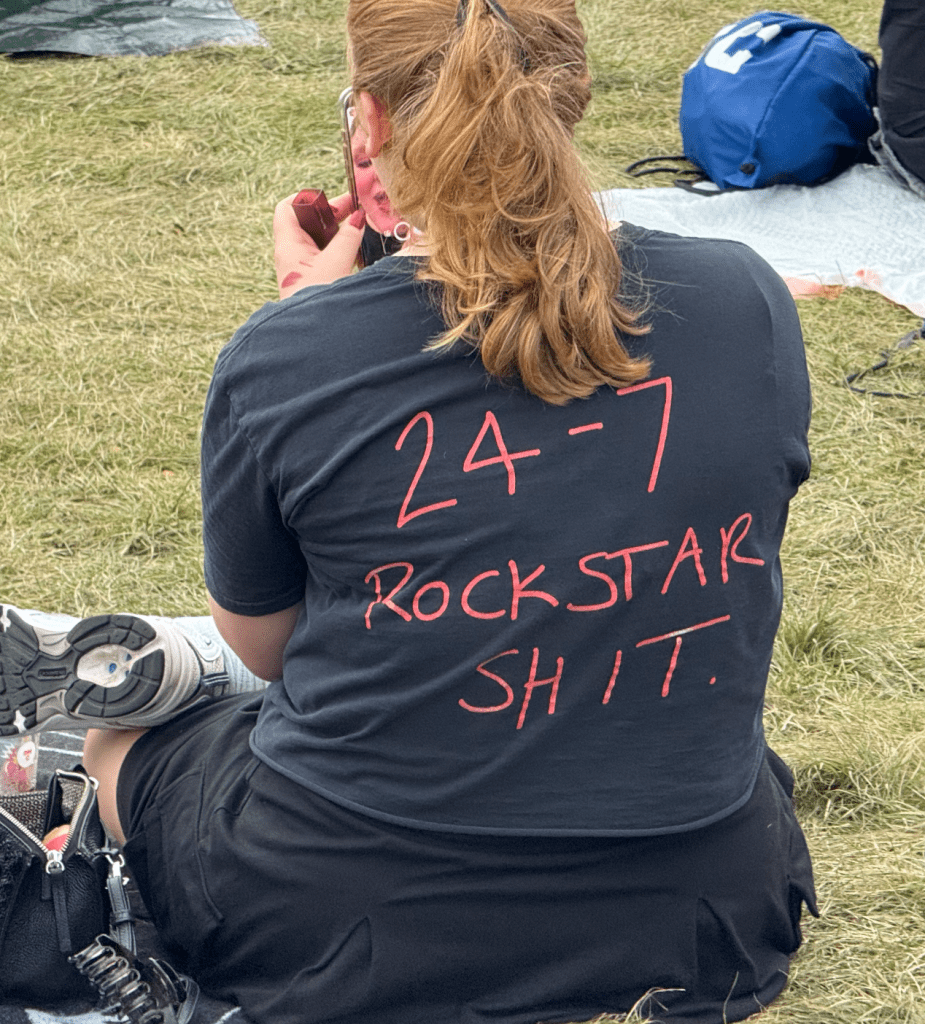
It’s the defiant enjoyment of an underdog, the momentary exuberance of the overlooked on display, a message that “the world may be increasingly awful, but I’m going to find my fun, and so are my friends.”
On the Riot Stage as a headliner, musician Jack White proclaimed his defiance to the oppressors du jour to a crowd of thousands: “Ain’t no one in control tonight. Ain’t no MAGA fascists in control tonight. Ain’t no ICE Gestapo soldiers in control tonight! Rock and roll is in control tonight!”
I look around at all the kooks, the plus sized men in party dresses, the butch women in leather and fishnets, the ubiquitous tattoos and piercings, people of all stripes fearlessly parading their weirdness.
While I never dressed like them, the punks infused my developing aesthetics with notions of social justice and artistic integrity. Almost fifty years removed from the punk I knew as a boy I was still “vibing well” with punkish Riotfesters.
I first heard of punk in 1976, in Paul Turdick’s basement, where a bunch of the neighborhood boys happened to be gathered. No one was really paying attention to the 12-inch black and white TV. When, “wait, turn that up!”
The voiceover told of riots, public indecency, and rock and roll mayhem happening in merry olde England. Teenagers dressed in combat boots, mohawks, and rag clothes stitched together with safety pins. Piercing their flesh with those same pins, hopping and thrashing with their mates in manic 2/4 time. They pushed each other violently and–”What? The lead singer spits at his audience!?”
On the edge of high school, we shook our heads. “What the fuck was that?”
And yet, how intrigued I grew, my 15 and 16 year old mind starting to open to the world outside Oak Park. Illinois.
By 1978, the Sex Pistols’ Never Mind the Bullocks was one of my favorite records.
 The Wikiness
Leave a comment