“Psst. Guess what? Mother Nature and I are partners. We’ve negotiated, and she’s giving me rich harvests and beautiful flowers in return for simply playing by her rules.”
The first step was reading and meditating on Braiding Sweetgrass: Indigenous Wisdom, Scientific Knowledge, and the Teaching of Plants by Robin Wall Kimmerer. I absorbed its Pottawatomi ethic of reciprocity with plants, anthropomorphizing trees as “Standing People,” etc. A Native American taking food from Nature would always leave something of value, like tobacco, in the place s/he harvested. It was a token of mutual respect between humans and plants, an acknowledgement of our fellowship on the great wheel of life.
“I’d like to do something like that,” I thought.
Kimmerer’s book is a call to arms for every human stewarding even a small piece of suburban land. Through her lens, the prairie that was here before development, a thriving web of myriad living things, can still be seen in each vestigial bird or flower. And starting small, that former ecology can be restored.
The suburban monoculture of lawn looks good, but it is a blade that cuts the healthy web, bleeding biodiversity and strength: polluted aquifers, flooding, water shortages, and the exile of entire species result.
What repairs the biome can be informed gardeners like me, my wife, and my neighbors, Robin and Gayle. We started by reclaiming the public parkway corners at our nearest intersection. We removed the grass and brought in pollinator-friendly native species to attract birds, bees, and the growing admiration of pedestrians. The corners now brighten the day for the school kids who use them as bus stops. In reclaiming these corners, we created safe spaces for humans and our fellow creatures.
With my wife’s support, I extended the re-wilding project to the backyard, deliberately leaving the middle half of it fallow, bypassing it with the lawnmower and letting it return to whatever prairie was possible under its blend of Kentucky bluegrass, fine fescue, and perennial ryegrass.
In return for our placing our small patch on the big wound of civilization, Nature has largely left alone our zucchini, tomatoes, eggplants, squash, and peppers. They grow safely to maturity in their beds.
Is it a coincidence that when there was nothing but lawn about those beds, we were sorely preyed on?
In the front garden this year, we expanded the flower bed with about 20 square feet intended for native plants to be decided upon later. No firm plans, just no lawn.
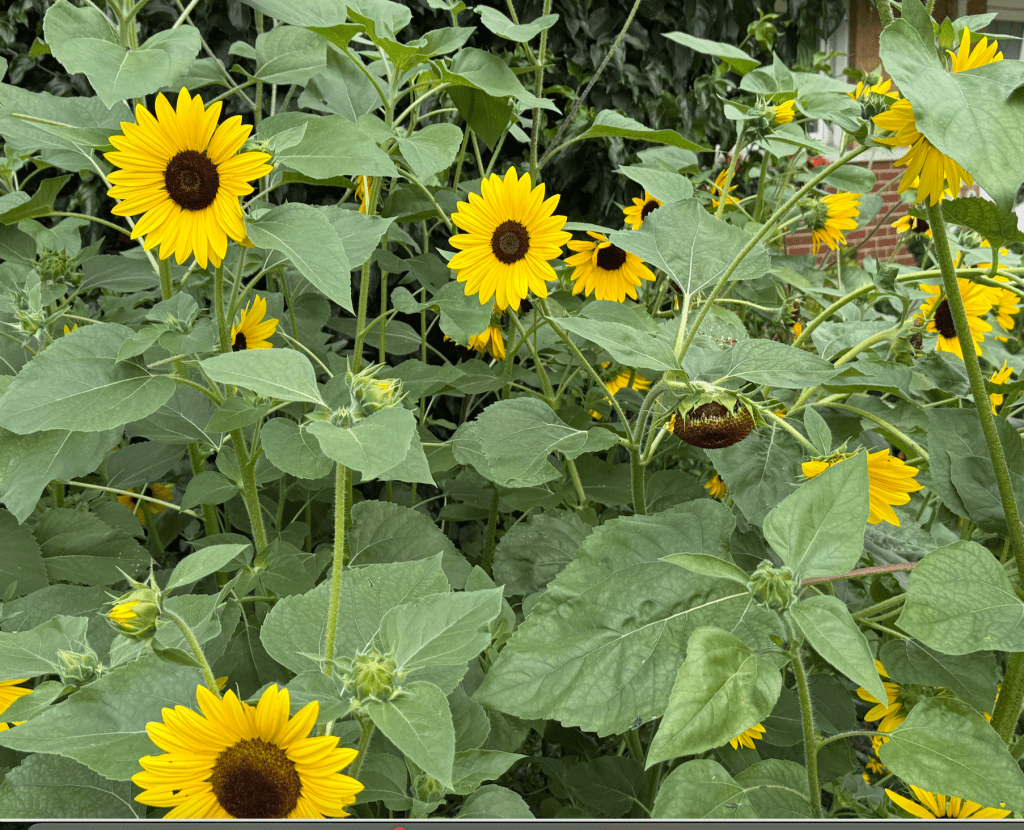
Miraculously, a whole bed of sprouts emerged in early spring, where nothing was planted. The brightly hued Tithonia Diversifolia, with its bright flowers, was by Nature’s obscure hand lent to our undeveloped earth as soil-builder and pollinator magnet, free of charge.
In this year of political animus toward our southern neighbor, the Mexican Sunflower has, beyond human laws, invaded our land and brought–not mayhem and a weaker America–but natural beauty and indigenous order that even my MAGA flag-displaying neighbors admire.

 The Wikiness
Leave a comment