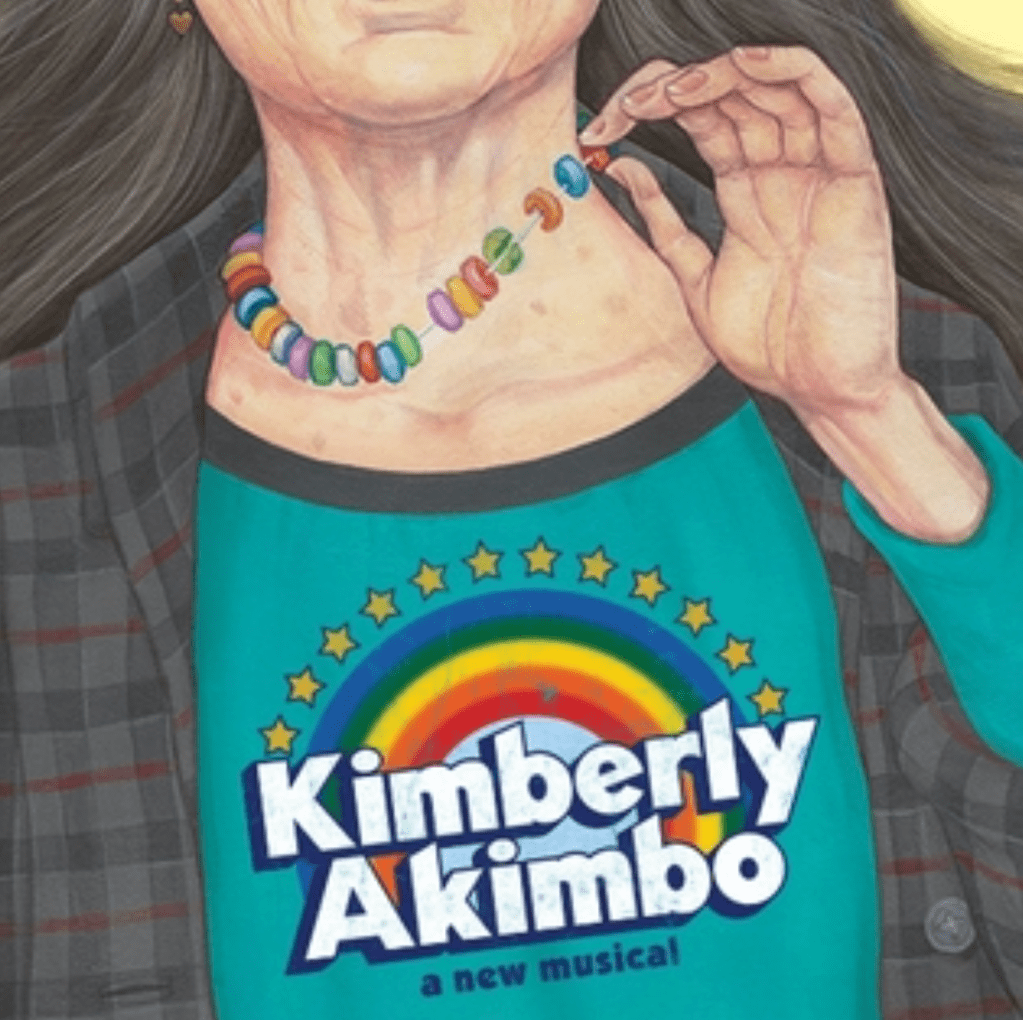
I am naive about Broadway musicals, knowing only the “greatest hits” of the last several decades–the shows that got filmed or televised, or that my musical-obsessed daughter insists I see. So I went into Kimberly Akimbo, in Chicago for 12 days only, with a “beginner’s mind,” not wanting to know the barest outlines of its plot.
On its own merits, this play won my innocent theater-going mind with its well-produced songs and choreography, its “let’s make the most of this” message, and its spot-on representation of “loser” high school teens in the late 90s/early 2000s. The show brought me back to the pre-iPhone age, when teens (and adults) related face-to-face, in real life, in shared spaces. Not cool enough to be invited to parties, these Bergen County, New Jersey “rejects” all meet at the skating rink, where the show begins.
Among the teens, there’s an anxious, closeted gay fella, a closeted lesbian brainiac, a couple of sis nerds, and also Seth, the tuba-playing, Elvin-speaking 16-year-old who has a job at the rink renting skates. He becomes the love interest opposite Kimberly, the biggest freak of all.
When we first see the title character, it’s cognitive dissonance. Here’s a woman in her 60s dressed in teen clothes at a skating rink with a bunch of teenagers. What is this greying human doing among the vibrant youth. Should we call the manager?
Well, no. Kimberly has a rare genetic disorder manifesting in progeria: she ages 4.5 times as fast as others. In her 15th year, she looks 67. And like many seniors, she suffers from sore joints, aged skin, a weak heart, and pariah status. I know. Weird premise.
It’s rich with comic complications, but also tragedy. There is plenty of darkness in Kimberly’s world. Her very birth was traumatic for her parents, neither of whom has coped well with having produced “faulty” offspring. Mom is emotionally distant and self-obsessed. She even wears bandages from elective carpal tunnel surgery she’s undergone to be sure to hold and take good care of her replacement next child, now in utero. Even if she wanted to, this mom could not comfort poor, lonely Kimberly. Dad, meanwhile, has turned to drink to deal with his shitty life, which includes his willing cukoldry (his wife carries the child of a neighbor, a man with “safe” sperm), and although a loveable jokester, this father leaves Kimberly waiting in the cold two and a half hours for a ride and pressures her into lying about his having been drinking.
So just as he is about to turn 16, the age at which American teens imagine they become adultish, Kimberly knows that this is the average life expectancy of people with her condition.
The show’s happy chord progression songs clash with the cold facts of Kimberly’s situation, adding intriguing tension.
As her health falters, she learns and grows. One of the last songs reflect her stoical pragmatism:
Well, tomorrow we’ll do the same, or not
And tomorrow will come anyway, or not
And if not, well, there’s now.
Without spoiling it, I’d naively say in the end that this musical offered me a satisfying dose of both comedy and tragedy.
Wait, am I reviewing a melodrama?
 The Wikiness
Leave a comment