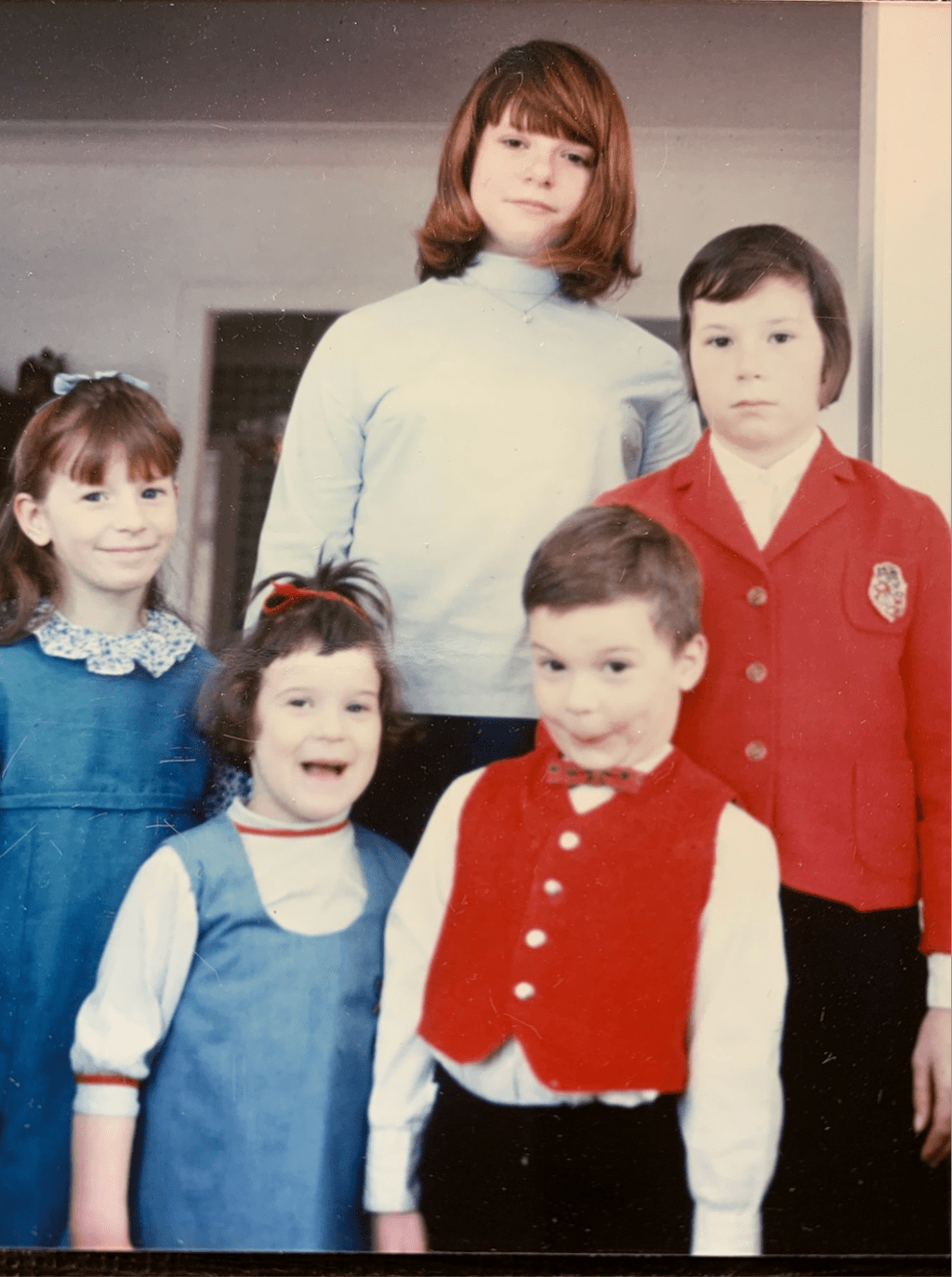
In 1971 and 72, when mom is bodily present between stints in psych wards, she disappears for days in deep chemical fogs inside her bedroom, inaccessible to us kids.
Into the motherless void steps fifteen-year-old Sharon, who becomes a loving presence for her younger siblings, Sheila, Sarah, and me. It is Sharon who in mom’s absence assumes the maternal tasks of meal preparation and housekeeping. She does so without complaint, perhaps animated by the esteem that accelerated responsibilities can give a child. It is Sharon, not my oldest sister Sue, who comes up with imaginative games to entertain “the little ones.” She instigates hours-long fantasy narratives of struggles with, and magical protections against, a villainess from her imagination: “The Witch of Eagle Seegal.” Sharon recounts thrilling backstories, and when she gets to the wicked witch’s boast, her voice gets high and piercing: “I am the Witch of Eee-ee-gle See-ee-gal!” she menaces us, but her characterization is reassuringly comic. Sharon’s imaginary terrors serve, I think, to make the real ones we face less terrifying.
To the younger kids, Sharon is the “safe,” nurturing older one in the house, so it is natural that we seek refuge with her. Sue and Sharon share a bedroom, and in their closet, all the children cower one day in 1966 or 67, when my mother in her insanity is trying to ease her suffering by killing her children with a butcher knife. According to my older sisters (for neither Sarah nor I recall the incident in 2020, when we heard of it), it is only my mother’s shouted threats and curses at us, heard by next-door neighbor Mrs. Aiken, that brings the police to our door and an end to our mortal terror.
Sharon loves listening to music, and brings sounds that are foreign to our south Oak Park turntable: exotic, latin-fused music like Sérgio Mendez and Brasil ‘66, and then vocalist Lani Hall, whose 1972 album Sun Down Lady is one of her favorites.
No one else in the family sees me without distorting emotions. Dad is jealous of me, Sue hates everyone, Sheila and Sarah I keep well-terrorized. Sharon is the only one who appreciates weird me with my artistic proclivities. By encouraging my artistic development, she nurtures my spiritual growth– as much or more than weeks of Bible Camp could. When I am eleven, Sharon the teenager pays for my lessons at the Oak Park Art League, where I learn and grow as a painter, and take pride in the ribbons my paintings receive at group shows.
At one particularly awful time–I am turning ten–no one in my family remembers it is my birthday. All day, I’ve silently registered ignorance of my special day on my father’s and other sister’s faces, knowing that everything was more important than me and my stupid life. I sit alone at the kitchen table, contemplating my worthlessness, when Sharon, somehow knowing my mind, comes up behind me with a single birthday candle stuck in a piece of pie she’s somehow secured. She sings “Happy Birthday” for me and pops corn on the stove. She loves the loveless boy and saves him from further self-estrangement.
 The Wikiness
Leave a comment