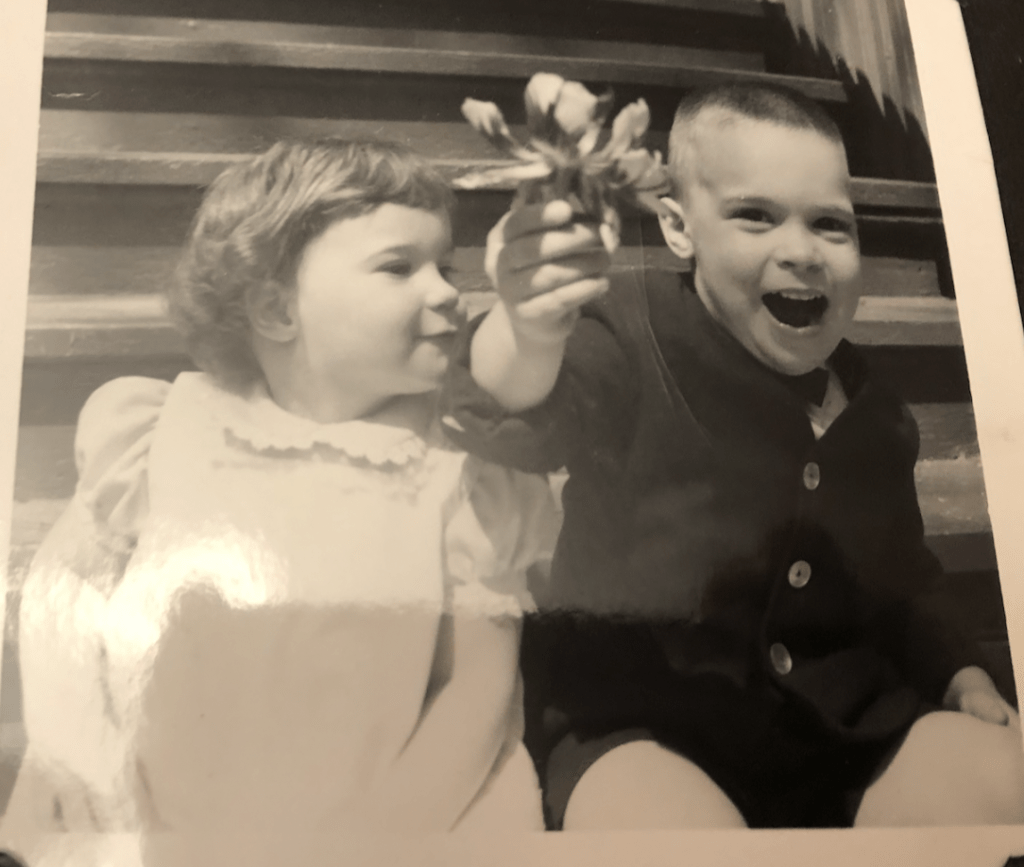
Oblivious to the presence of my sisters, my mother sighs wistfully to me. She recounts how, with each of her previous three pregnancies, her goal of a male baby had been cruelly deferred. But as a Christian woman, she kept faithfully praying and then–this blessed night at West Suburban Hospital when the nurse handed her me, saying “it’s a boy.” The heavens seemed to open and pour out God’s love for her.
Just like that, her patriarchy-born mission–provide a healthy son to carry on the family name–was gloriously fulfilled. At last, she felt accepted, an accomplished woman in the eyes of her society. Sufficient, at last. She tears up. The cup of her post-partum joy still runneth over.
But then what?
Alas, the supreme sense of contentment at my birth will not last.
My mother had conflated birthing a male child with her entire life’s purpose. Once she had me, all of her dream-invested energy had to go somewhere else. And her immediate circumstances–with no surrounding community to support her growth into a full, multi-dimensional human –left her nothing: no larger or replacement purpose, or even satisfying smaller goals that might give her a sense of fulfillment.
My sincere, passionate mother, as the provider of girls only, had prayed to achieve the boy that would make her, in her evangelical, traditional world, a worthy woman. But having received her blessing with rejoicing, she could not hold on to her joy. So what did she do with her energy? It went in darker directions–into the spaces American society makes available to the unsatisfied, though not without cost. To regain a feeling of pleasure, motivation, and satisfaction in her life, she turned to pills and alcohol, which reliably controlled her moods and gave her the numbness she sought.
If only mom had found a craft or interest that did not violate the norms of her culture! With a healthy outlet for her energies, she could have been like her church friend, the poet Luci Shaw, who in her work to this day uses Walt Whitman-esque free verse to explore the intersection of Christian scripture with lived experience.
If only mom had her crisis ten years later, when American hospitals began treating addicts more as people with medical conditions, she could have found alternatives to thinking of herself as a terrible person.
Aggravating Patty’s problems was a lack of access to the new ideas about women’s rights just then arising in the world, ideas that–who knows?–could have inspired new, productive goals in her life.
Though she was an avid reader her entire life, it is almost certain that at the time of my birth, 1961, Patty was unaware of Simone de Beauvoir’s influential The Second Sex (1949). Betty Friedan’s best-seller, The Feminine Mystique, wouldn’t be published until 1963, and by that time, Patty was wallowing in despair at my sister Sarah Fontaine’s arrival: alas, another girl.
In a deep bitterness that persisted many years, my mother would tell my younger sister, when she was old enough to understand, that she should have been a boy.

 The Wikiness
Leave a comment