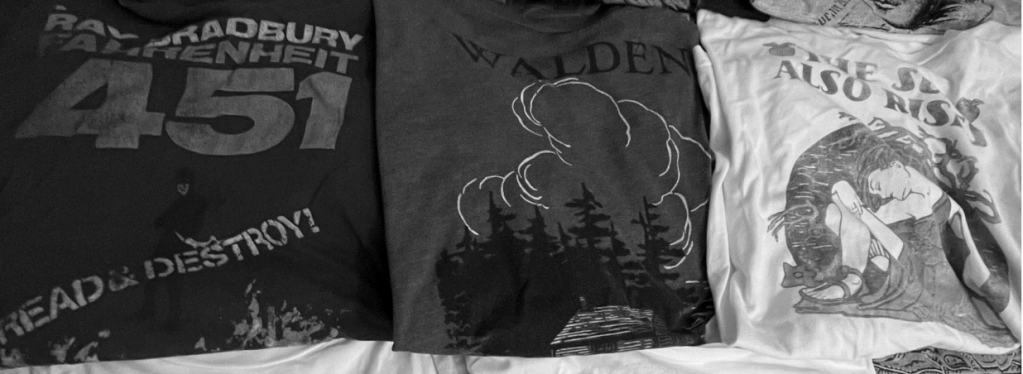
I have been on a “less is more” mission since retiring from 36 years of high school English teaching. Today, it’s my closet’s turn.
Those silk ties in school colors? The cheesy education-themed ones? They smell of yesterday’s oppression. They were service collars used to entertain the public’s children. Gone!
Uncomfortable, redundant, or outworn clothes? Into the donation bag!
But in my closet is a set of shirts that, to my nose, reek of “sentimental value,” so much that I stay their execution and let them hang around.
To an objective eye there’s nothing special about this colorful set of t-shirts and one pair of polos. But the amount of dopamine they indirectly spurted into my brain–the value-aligned behavior that wearing them gave me on one hand, and the professional status and ego attachment on the other–make them worthy of words of tribute before I give them away.
Over time, these shirts built and represented my “brand” at my school. They symbolized my values, showcased my achievement, and expressed my purposes to students and staff alike. They were part and parcel with my professional persona, one I felt proud to be serving. They now seem to me not the disused uniforms of a forgotten war, but brave banners that waved over bloody fields of victory. These are the uniforms you hang in places of honor, like museums, not trade for trinkets at the Salvation Army surplus store.
Walking the halls of York Community High School in one of the dozen or so Out of Print books dot com. “lit shirts” in my closet made me feel aligned with my values. It was a weekly reminder that I was part of a team doing important work for America.
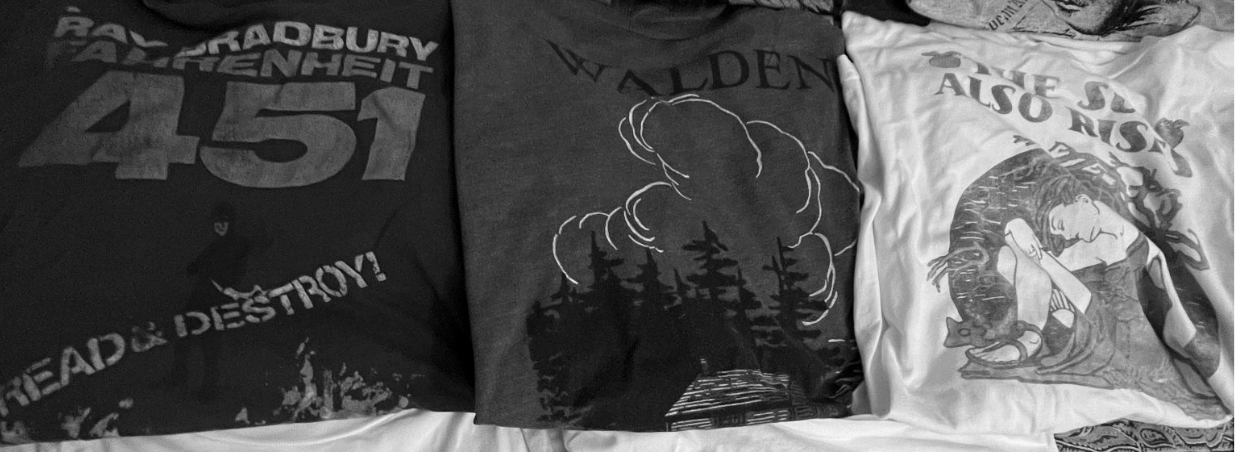
The front of each shirt portrays the published cover of an “out of print” edition of a classic work, but for the York English teachers, it was a visual celebration of our stock in trade, a symbol of our joint purpose. The shirts advertised to students around school our enthusiasm for literature. We hoped, mostly in vain, that the shirts would spark spontaneous discussion with kids–you know, about important ideas and poetic craft–as we moved through our Wednesday. At best, it would be, “Oh, I hated that book,” or “My friend said she liked that book,” and a conversation was underway, the holy cause of literacy advanced.

The shirts were also a wardrobe respite, a Casual Friday in the middle of the work week. It was also a chance to express ourselves. Ms M– would often wear To Kill a Mockingbird shirts (she had named her daughter Scout.) Ms. F– favored Jane Austen. Depending on my mood, I might wear a Lord of the Flies, a Walden, or a Handmaid’s Tale. In my mind, wearing a particular lit shirt could also send an obscure message, a meek middle finger, to the man, whose policies and philosophies I often disdained.
English teachers fetishized and rhapsodized the shirts. A surprisingly big part of department culture and practice centered on them. They were strategically deployed (“the 11 team will all wear Gatsby gear next Wednesday as we begin Fitzgerald’s masterpiece”).
Upon reflection, the significance we placed on the shirts is pathetic. The reason we all felt so good wearing them was that in the heavy, soul-crushing slog of the school calendar, with paper-grading weekends and evenings, wearing a shirt of our own choice felt liberating, a patch of blue volition in the gray firmament of school board conformity.
 The Wikiness
Leave a comment