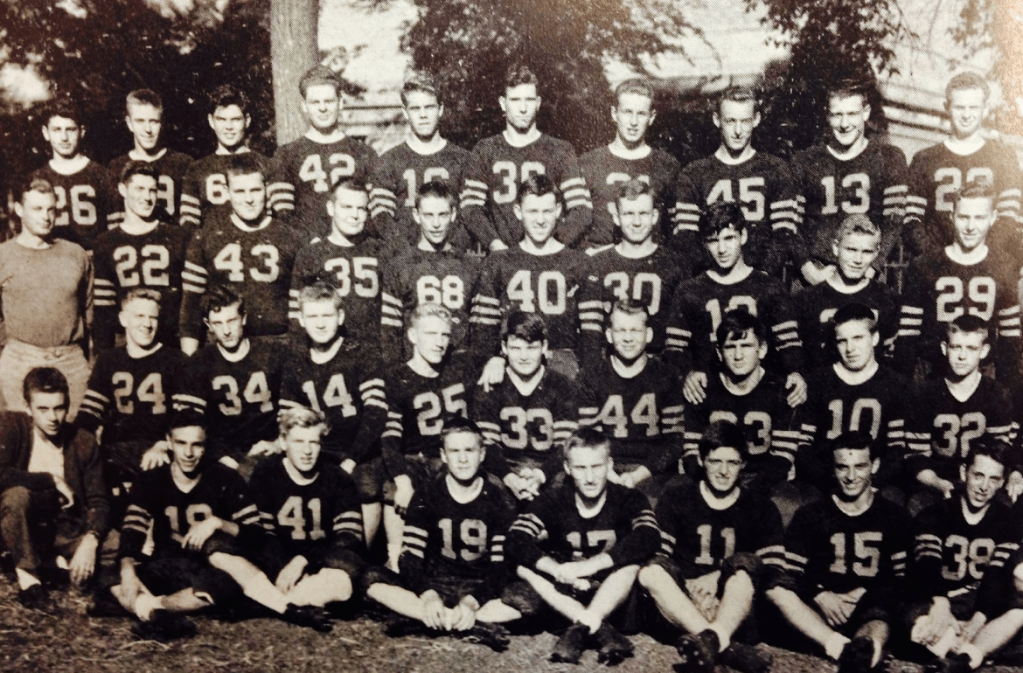
Sports were one place dad felt comfortable interacting with me. Otherwise he acted as men who came of age in the 1940s and 50s did: strong, silent, and cool. Except when it came to sports. In the presence of an athletic contest, dad re-animated. Watching a game on our black and white TV, he’d explosively yell at the action.
“Oh, for the love of Pete!” when things went wrong. And for the Chicago Bears of this era, that was often. When the Monsters of the Midway did well, it was, “That’s the way, boys!” And his delight felt calm and reassuring.
He welcomed my presence in front of the tube with him on these occasions, and would explain to me the rules of game.

I knew from dad that the only teams in the world worth rooting for were the Bears, Cubs, and Blackhawks. So on my own, I copied his behavior. One summer afternoon, I turned on Channel 9 and watched the Cubs.
Dad had told me that Ernie Banks was Chicago’s best player, so I expected a home run when it was his turn. Number 14, a black man, stepped up to the plate, waved his bat, and I was ready for greatness.
What a surprising let down when my first Ernie Banks at bat resulted in a dribbling bunt down the first base line. He was thrown out. I didn’t yet grasp the whole “sacrifice” concept.
Another place that dad, sports, and I intersected was at our church’s Father-Son Banquet the year that Cubs catcher Randy Hundley was special guest. My dad was excited by Hundley’s Fellowship of Christian Athletes talk, which referenced people I didn’t yet know, like Leo Durocher and Billy Williams. And though I hadn’t asked him to, dad proudly presented me with Hundley’s autograph that night in a small book dedicated to the purpose. I now wish I still had it, more than 30 years after dad’s passing.
Around this time I got into T-ball. Dad bought me a glove, ball, and bat, and began playing catch with me, which I loved. We’d go out onto the sidewalk, and he’d toss the ball to me. I stuggled at first to catch it and throw it back. He patiently showed me how.
“Hold your arm like this, Drew,” he’d say, and I imitated him. This was dad’s love language. He was doing his best to help me become a 20th century American male before it was too late, and my doting mother and sisters sissified me beyond repair. This was probably also why he punished me with his belt.
My right of passage into this American masculinity occurred one day in July 1967 at the Friendly Confines of Wrigley Field. Of course, I’d seen the field and its ivy-covered outfield walls many times on our black & white Zenith. But nothing prepared me for the feeling I got when, holding dad’s hand, I emerged from under the stands into the box seats to see it all in living color. The green of the grass and ivy was greener than any I’d ever seen. The white of the foul lines glowed, and the dirt of the pitcher’s mound and infield was a lovely reddish/brown I’d never imagined. It overwhelmed me.
The vision melded perfectly with the organ melody wafting merrily overhead. Here with me were all the men of my family–my grandfather Ernie, my father’s brother Tom, and his son, my older cousin, Craig. I felt fraternally united in a righteous place of wholesome, beautiful competition. Here we were tasked with nothing more than recording the unfolding game on scorecards, cheering and booing, eating hotdogs and frosty malts, and drinking Coca Cola.
Whether the Cubs won against the hated Reds of Cincinnati that day mattered less than that dad had inducted me into the society of American men.

Dad is long gone, but every time I find myself irrepressibly shouting at a game, I feel my old man still with me.
 The Wikiness
Leave a comment