But they are tell us what teachers are still good for: “organic,” or non-programmed responses to the learner. A factory worker’s job, easily roboticized, is not a human teacher’s. Javier Movellan, founder of the UC San Diego Machine Perception (MP) Lab, explains:
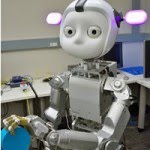 “Up to recently, robotics focused on applications to very structured conditions, like industrial fabrication plants. In such conditions, you can solve most of the theoretical problems—inverse kinematics, inverse dynamics, trajectory generation, trajectory control—analytically,” he said.
So as the N. American school year begins again, and parents and school boards around the country begin to ponder the worth of their children’s teachers, they might remember that–for the next several years at least–they will have to continue dealing with their difficult to manage human teaching machines. They will have to continue honoring their outrageous benefit packages and salary demands. The robots have not learned to teach… yet.
And the teachers? Might they not wish to explore more deeply what makes them indispensible? The article quotes Jacob Whitehall, who puts it this way: “Putting your heart into teaching, wanting to help your students and make them feel good about learning—that is not easily replicable by any kind of hardware.”
 The Wikiness
Leave a comment